
Columbia County Busted Mugshots
A mugshot is just an identification photo taken at jail intake. Around it sits the booking record: name, booking number, arresting agency, charges listed at booking, bond details, and whatever else the custodian keeps. Don't confuse these with an arrest report, which describes the law-enforcement event itself, or with a court docket, which tracks the case once it reaches a judge. The three can cross-reference each other. None stands in fully for another.
Sheriff Clay N. Whittle's Columbia County Sheriff's Office runs the Columbia County Detention Center in Appling. That facility is where most adult arrests in the county end up, whether deputies made the stop or a city agency like Grovetown DPS or Harlem Police did. Those two cities keep their own initiating police records. Appling, the county seat, is unincorporated, so CCSO handles both policing and detention there. A booking simply records intake after an arrest.
Georgia's public-record rules cut both ways. A record can exist and be requestable, yet an agency may still withhold or redact protected material, and a photo can be retained without ever appearing on a public website. That tension is the heart of Columbia County busted mugshots. The official online custody list has come down. Its absence tells you nothing about whether someone was booked, released, transferred, or never held in the county at all.
Columbia County Booking Records
Booking work at CCSO covers intake and release processing, mugshots, and fingerprints. That scope comes from the CCSO deputy-jailer description. So a responsive packet can hold more than a photo. What actually gets released depends on what CCSO maintains and which exemptions apply. The old web inquiry published no field schema. So name the person, give an approximate booking date, and specify the records you want.
Treat the field list above as a checklist, not a guarantee. The incident narrative likely sits with the arresting agency. The jail intake record sits with CCSO. Docket events belong to the court clerk. Any state-prison profile belongs to the Georgia Department of Corrections. Keeping those custodians straight is what makes a Columbia County mugshot request precise.
| Possible field | What it can show |
|---|---|
| Name and descriptors | The booked person's name and identifying details used to distinguish similar names. |
| Booking or inmate number | The identifier assigned to the intake record, if maintained and releasable. |
| Arrest and booking date or time | When the arrest occurred and when detention-center intake was recorded. |
| Arresting or committing agency | The agency that delivered the person to the detention center, such as CCSO, Grovetown DPS or Harlem Police. |
| Charges as booked | The charges recorded at intake. These are not a final court disposition. |
| Bond information | Bond type, status or amount when included in the booking record. Bond is not a fine or a finding of guilt. |
| Booking photograph | The intake image, subject to Georgia law, public-record exemptions and the response to the request. |
| Court or case reference | A court date, docket or case number that can help connect the booking to later proceedings. |
| Custody or release status | A detention or release detail maintained by the detention center, if responsive to the request. |
| Holding facility | The facility responsible for the person at the relevant custody stage. |
Agencies can withhold or redact certain material. That includes personal, medical, juvenile, victim-sensitive, sealed, restricted, or active-investigation content. If CCSO denies part of a request, ask which legal exception they're relying on. And don't read a missing field as proof the event never happened.
Note: A booking packet can be releasable even when the live custody list and photo display are unavailable.
Access Columbia County Busted Records
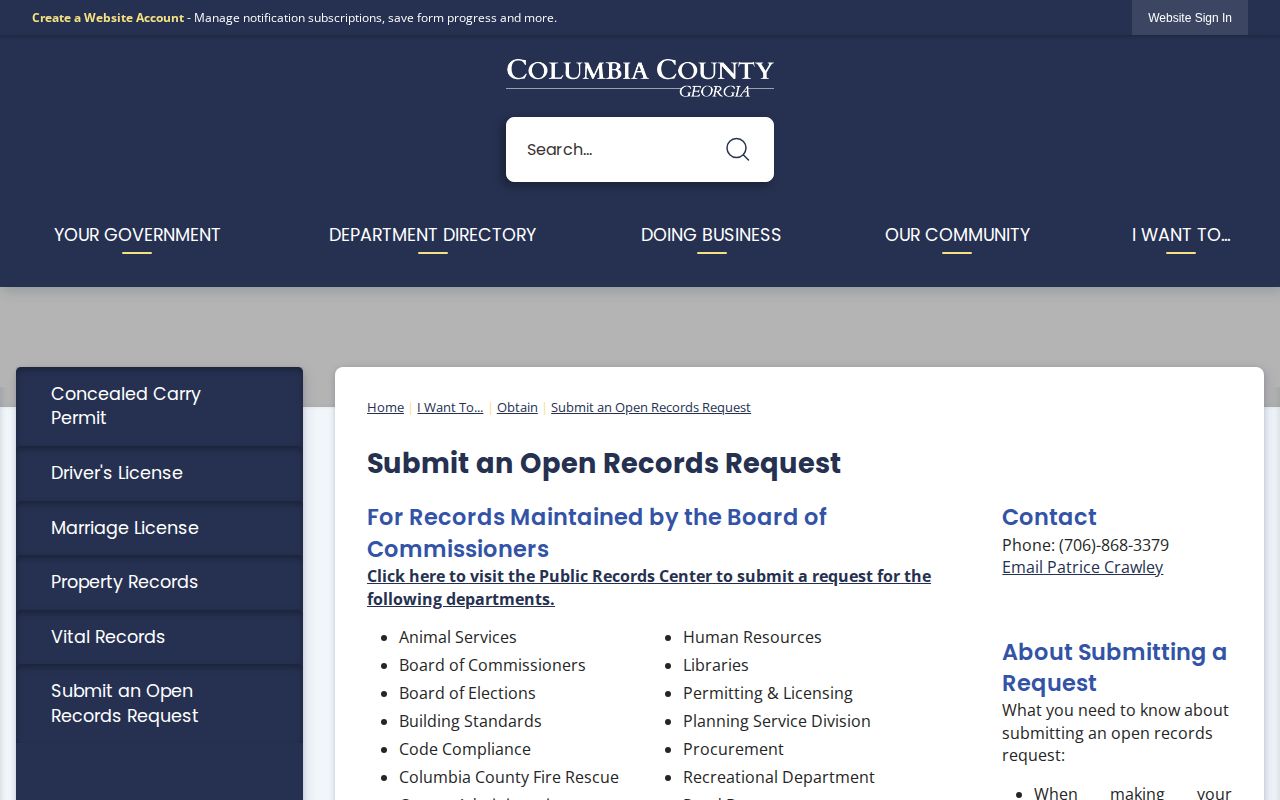
All Sheriff's Office requests go through the county's Public Records Center and open-records instructions. The records information line is 706-541-1042. The open-records officer keeps weekday hours, 8 a.m. to 5 p.m. State law gives the custodian three business days to make the record available, offer a timetable and cost estimate, or cite an exception. That clock starts a response, not a finished product. A large request may take longer.
CCSO's Records Section takes requests in person or by mail at 2269 County Camp Road, Building G-2, Appling, GA 30802. A substation is listed at 650A Ronald Reagan Drive, Evans, GA 30809. A criminal-history letter runs $10 cash. No flat fee for a booking photograph has been published. So don't assume the letter fee covers a photo request. Ask for a cost estimate before search time, copies, or redaction work climbs past what you're willing to pay.
- Identify the requested record as an existing booking sheet, booking packet or intake photograph. Include the full name and an approximate booking date.
- Add the arresting agency, case number or booking number when known. Ask for an electronic copy if that format is available.
- Submit through the county Public Records Center or the CCSO Records channel. Keep the request focused so the custodian can locate the right file.
- Review the response, estimate and any redactions. If something is withheld, ask which exemption supports the decision and whether a releasable portion can be provided.
Routing matters. If Grovetown or Harlem made the arrest, send the request to that city agency for the incident itself. For a jail intake image, target CCSO and the Columbia County Detention Center. State which date you're approximating. The arrest, booking, and release dates may all differ. A narrow request naming one person and one record type is far easier to verify than a sweep of every recent bust.
Start with the county's official open-records request page to submit any CCSO records request.
Note: The $10 criminal-history-letter fee listed by CCSO is not a published fee for a booking photograph.
Georgia Mugshot Rules and Access
Georgia leans toward openness. The Open Records Act, O.C.G.A. §§ 50-18-70 through 50-18-77, gives the public a right to existing agency records, with exemptions, response rules and fee limits along the way. A custodian need not build a report from scratch. Releasable items may also arrive with protected details blacked out. Booking photos have their own layer: O.C.G.A. § 35-1-19 sets conditions for when an agency may post or disclose them, which helps explain why a sheriff's office can hold an image without publishing a photo roster. Read the current statute and the CCSO form before filing a request.
Removal has a statutory path too. Under O.C.G.A. § 10-1-393.5, a defined subject who qualifies through outcomes like dismissal, nolle prosequi, no-bill, restriction, first-offender completion or acquittal can demand a covered publisher drop the item for free within 30 days, provided the required information and delivery method are used. Not every case result qualifies. Georgia also uses "record restriction" for limiting access to eligible criminal history, and the Georgia Bureau of Investigation restriction guidance notes that restriction does not erase every copy, news story or independently held image. The official route can run through the arresting agency or the prosecutor, depending on the arrest date and how the case ended.
Two publishers offer their own no-cost procedures. RecentlyBooked's policy cites dismissal, sealing, expungement, wrong or outdated details, wrong-person entries, juvenile material and duplicates as grounds, and asks for the page URL, name, arrest date, state, county, reason and any supporting documents sent to its listed email. Mugshots.com's Record Maintenance policy similarly handles expungement, sealing, restriction, identity theft, no-information and death cases with court paperwork, though it can take up to ten business days and may append a disposition rather than delete the item. These are private policies, not legal guarantees. Send a separate request to each appropriate record holder.
One more step often gets missed. After a source page truly changes or comes down, submit the stale link through Google's Refresh Outdated Content tool. That clears the search result only. The underlying government or publisher record still stands. Skip anyone demanding money; the statute, the custodian and the free publisher routes are the documented path.
Note: Record restriction limits access to eligible history, but it does not promise deletion from every independent copy.
Find Columbia County Busted Mugshots
The right search depends on the question. Are you asking who is in custody right now, hunting an old image, checking a court outcome, or tracing a state or federal transfer? No single Columbia County search answers all four. Start with CCSO or the arresting agency for the live custody question, then move to records and court sources from there.
- Confirm the agency and place. Appling and unincorporated areas point to CCSO; Grovetown and Harlem may have an initiating city record. Adult county bookings generally point to the Columbia County Detention Center.
- Check the official custody notice. The CCSO Inmate Inquiry page says the current list is no longer available online. Call 706-541-0754 or visit the detention center for a present-custody question.
- Request the historical record. Ask CCSO for the booking sheet and intake photograph, using a full name, approximate date and agency or case number.
- Use Georgia VINE/VINELink for custody-status notifications when the person or victim is eligible to register. CCSO lists 1-833-216-6670, TTY 1-866-847-1298, VINELink.com and the VINELink mobile app. VINE is an alert service, not a photo archive.
- Check the court docket for arraignment, bond, filed charges, dismissal, plea, sentence or another disposition. A person leaving custody is not proof that charges ended.
- Use GDC, BOP or ICE only when the custody system fits. A county arrest does not make a person appear in every state or federal locator.
CCSO offers a direct route for victims: Victim Assistance information that points to Georgia VINE. The District Attorney Victim Assistance Program sits at 7045 Evans Town Center Boulevard in Evans, GA 30809. The phone number is 706-447-6780. Calls are taken weekdays from 8:30 a.m. to 5 p.m. VINE sends alerts when a custody event happens. It won't hand over a booking packet, though. It also won't tell you a court outcome.
Unofficial busted mugshot pages can still serve a purpose. They may help you pin down a date or a case number. The gaps cause real problems, though. An aggregator can carry a stale charge. It might skip a release, blend counties that share a name, or leave a photo up long after the case changes. Check custody with CCSO, the arresting agency, or the right state or federal custodian. Then confirm any outcome with the court itself.
Note: A detention call answers present custody, while a records request answers what historical file may be produced.
Where Columbia County Mugshots Appear
Official sources come first. Each answers a different question. The table below splits current custody, historical records, state custody, court outcomes and secondary reporting into separate lanes. "Photo" means a source may show or provide an image. It does not promise one for every person or record.
| Channel | Photo? | Status | How to access |
|---|---|---|---|
| CCSO Inmate Inquiry | No current web display | Official | The list of people in custody is no longer available on the website. Use the detention phone or visit. |
| CCSO Records and Public Records Center | Possible if maintained and releasable | Official | Request a named booking record or intake photo and ask for an estimate. |
| Georgia VINE/VINELink | No | Official | Register for custody-status notifications through the CCSO victim-assistance page, VINELink.com or the mobile app. |
| GDC Find an Offender | GDC identification photo may appear | Official | Search a person in Georgia state correctional custody or a searchable former GDC record. |
| Columbia County court docket | Not a booking-photo source | Official | Use party or case information to follow disposition, then ask the clerk for certified proof when needed. |
| Grovetown or Harlem police records | Not verified as a public photo roster | Official | Request the initiating incident or arrest record from the city agency. |
| RecentlyBooked Columbia County | It reported no Columbia images | Unofficial | Its county category was stale and empty during the August 16, 2026 review. Do not use it to confirm current custody. |
| Mugshots.com Columbia archive | Historical images may appear | Unofficial | The visible archive ran through older arrest years. Treat names, photos and dispositions as incomplete. |
| Arrests.org Columbia archive | Archive may show photos | Unofficial | It is a secondary archive with no guarantee of current results, complete records or accurate outcome. |
| AugustaCrime and The Jail Report | May show publisher images | Unofficial | Countywide weekly or batch coverage can be incomplete and can lag the booking. |
| Georgia Gazette and regional news | May show an agency image | Unofficial | Use as a discovery or case-following lead, then confirm with CCSO and the court. |
Busted Newspaper and Mugshots.zone do not appear to carry a Columbia County, Georgia local section. Don't settle for a same-named county in another state. Secondary coverage also includes the event-driven WRDW crime newsroom. News judgment means it never amounts to a complete arrest list. None of these substitutes for the originating record.
The Busted Booking Roster in Columbia County
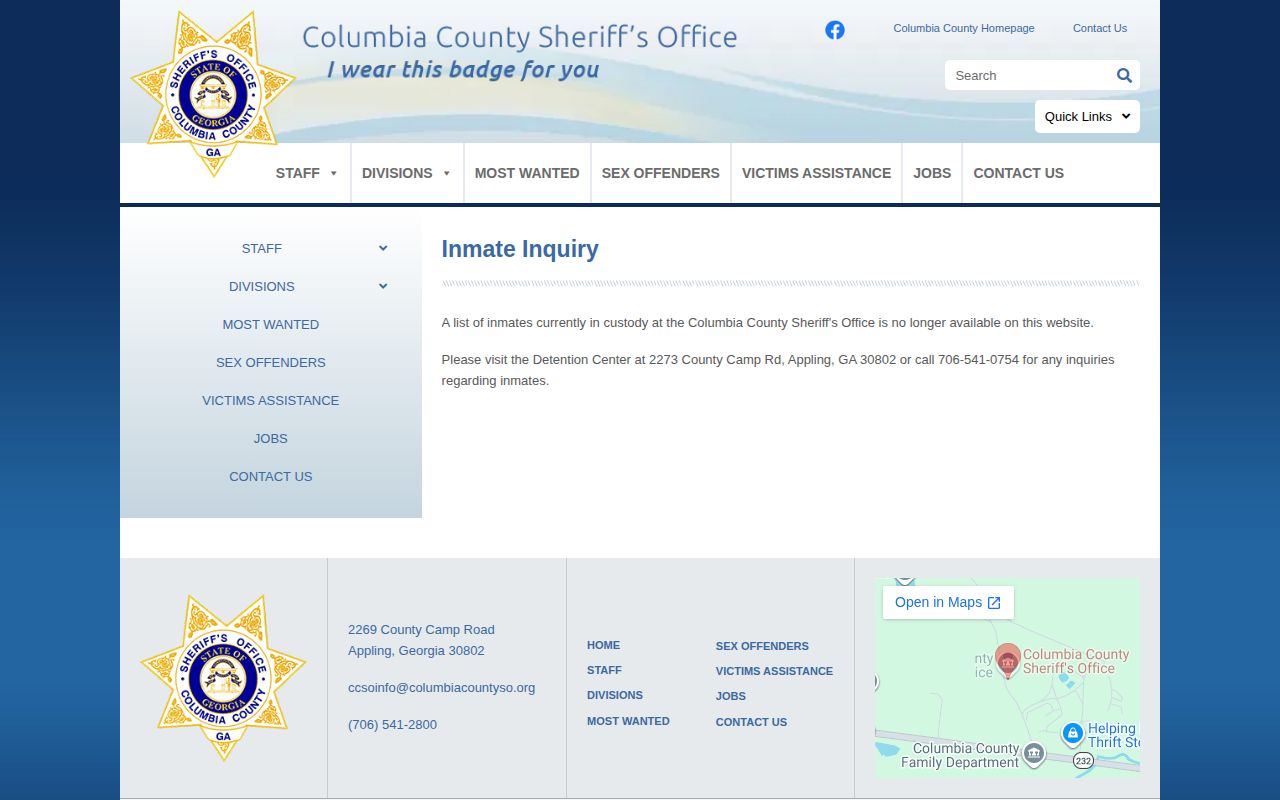
Want the county jail roster? Columbia County has pulled it from the web. The CCSO Inmate Inquiry page still loads, but its own notice says a list of people currently in custody is no longer posted online. Visitors get two options instead. Come to the detention center in person, or call 706-541-0754. That means no public web roster, no search form that works, no photo display, and no stated window for how long anything would stay posted even if it were.
The official CCSO Inmate Inquiry notice is the source for the discontinued-roster finding.
So what does the roster's search screen actually offer? Absent fields. That's it. There is no hidden promise of deeper filters tucked behind the booking list.
| Potential web field | Current official status |
|---|---|
| First or last name | No current public field. The custody list is not published. |
| Booking or inmate number | No current public field and no public result model. |
| Arrest or booking date | No current public field; no public date window is disclosed. |
| Charge, agency, age, race or sex | No current public field. Do not copy platform fields from another county. |
| Booking photo | No current official website photo display. |
| Release date or post-release persistence | No current public web field and no online persistence period documented. |
- Read the live notice before trusting an old search result or cached instruction.
- For present custody, call the detention center at 706-541-0754 or visit the official location in Appling.
- For a past booking or photograph, use CCSO Records and state the name, date and record type.
A leftover Police-to-Citizen page sometimes surfaces in search results. It may ask for a first and last name before showing anything. That is not an open roster. It does not override the sheriff's notice either. A name search that returns nothing proves only one thing: the search failed. It does not prove the person was released.
Note: A live CCSO URL can remain available after the searchable list behind it has been withdrawn.
Why Columbia County Busted Searches Go Stale
Old instructions die hard. The Inmate Inquiry address still resolves, and a disabled recent-arrest module can sit there looking alive, which is exactly why a stale guide keeps getting shared. But the county has no enabled recent-arrests module today, no 24-hour or 48-hour booking page, and no person-level feed behind that notice. Access changed. The sheriff's office did not stop creating booking records.
Treat the URL as a place to read the current notice, nothing more. For who is in custody right now, call the detention center or go there. For a past booking, file a records request. A link that still loads is not the same as a page that still works, so check the content date and the agency's own instructions before trusting any search result.
Busted Last Night in Columbia County
Could you find out who got busted last night? Not through the county. There is no official CCSO feed covering the last 24, 48, or 72 hours, and no weekly named arrest list either. Grovetown posts weekly activity reports, but they only give totals of subjects and charge categories. No arrestee names, booking numbers, bonds, or booking photos. Harlem offers no verified daily bulletin or standing named feed.
Feed-window result: no current CCSO web list can confirm a "busted last night" search. Call 706-541-0754 for present custody, ask the arresting agency about a completed report, or request a date-bounded booking record from CCSO.
Each channel moves on its own clock. A police report may still be incomplete when the person is already booked into jail. A custody call tells you who is held now. It says nothing about what a court might later decide. A records response can document a booking from long ago, even after release. Third-party sites with a "last 30 days" filter are not county feeds. A weekend date stamp there may just reflect batch processing, not the actual time of arrest.
Note: A weekly aggregate activity count cannot identify a named person or establish a booking time.
Georgia DOC Offender Photo Lookup
The Georgia Department of Corrections Find an Offender service answers a different question. It covers people in state custody. Some former GDC inmates stay searchable too. It is not a statewide arrest log. It also skips most people booked at the Columbia County Detention Center. Someone newly arrested and awaiting court stays a county-record matter until a transfer to state custody actually happens.
Search with the best identifier you have. A GDC number works well, or a careful name-and-detail combination. Common names and aliases produce false matches. So verify more than the photo. A GDC profile shows a correctional identification photo and custody details that shift over time. Use it for state records, not as a stand-in for a CCSO booking packet.
CCSO itself describes transporting people among the detention center, court, and GDC. That explains why someone can drop off the county side and later turn up in the state locator. A return to Columbia County for a court date is not a new arrest. When the locator gives no photo, request that GDC record from GDC directly. Do not ask CCSO to fetch another agency's file.
Booked or Released: Follow the Record
Custody status and case outcome run on separate tracks. Bond can get someone released while the case is still open. A person can stay held while a judge reviews bond. A sentence can move someone into state custody. Where the photo and paperwork sit changes with each of those states.
| Custody or case state | Best official channel | What it answers |
|---|---|---|
| Just booked or still in county custody | CCSO detention phone or in-person inquiry | Whether the person is presently held at the county detention center. There is no current public web roster. |
| Released from county custody | CCSO records request and court docket | Whether a historical booking record and, if releasable, the booking photo exist, plus what later case events are recorded. Release does not decide the charge. |
| Sentenced or transferred to state custody | GDC Find an Offender | Whether a searchable GDC custody record and identification photo exist. |
| Federal or immigration custody | BOP or ICE locator, as applicable | Whether the person is in the separate federal or ICE system. Neither is a county booking-photo source. |
| Case outcome | Columbia County Clerk or the relevant municipal court | Filed charges, bond orders, pleas, dismissals, verdicts and sentences, subject to the court's records and certification rules. |
When a Busted Arrest Reaches Court
Bond often moves fast here. CCSO's victim-assistance material notes that many accused people bond out within hours when bond is preset. If bond is not made within 72 hours, most people go before a judge. Certain serious offenses can only have bond set by a Superior Court judge. A preliminary hearing in Magistrate Court takes up probable cause. It also decides whether the case moves toward State or Superior Court.
From there the courts split the work. Magistrate Court handles warrants, probable cause, and preliminary stages within its jurisdiction. State Court generally takes misdemeanors and traffic matters. Superior Court handles felonies and whatever else Georgia law assigns it. Grovetown and Harlem run their own municipal courts. Still, a city arrest can end up prosecuted at the county level.
A booking photo and its caption only mark the start of a case. Charges can change, get reduced, or vanish. The court file, not a busted arrest listing, tells you what happened next.
Look for accusation or indictment, bond order, arraignment, plea, dismissal or nolle prosequi, verdict, sentence and later restriction-related order. A booked charge can differ from the filed charge, and the filed charge can differ from the final disposition. If online information is incomplete, ask the clerk for the case record or a certified copy.
Note: Release from county custody is a custody event, not a court disposition or proof that charges ended.
Columbia County Bond and Release Steps
Getting out of the Columbia County Detention Center happens in three ways, according to CCSO: time served, a court order, or bond. Bonds come in property, cash, and professional forms. Each bond that starts in Columbia County carries a $20 fee. A property bond of $25,000 or more needs proof of equity.
One catch trips people up. Release processing checks every charge a person is held on. It also runs another wants-and-warrants check. So posting one bond does not mean the doors open right away. Bond itself is just a promise or security tied to release conditions. A person can be out and still have an open court case with future hearing dates. To understand a specific bond order, read the court record or ask an attorney. The CCSO general information page is the source for these local bond details.
That split shows why a busted mugshot is not a case history. Jail staff handle release conditions. The court runs the case, and the sheriff's records unit answers records requests. Each office holds one piece of the timeline.
Columbia County Booking Volume in Context
The detention center holds 358 beds. CCSO says about 4,000 people pass through it every year. Several agencies send people there, including Georgia State Patrol, Grovetown DPS, Harlem Police, and the Georgia Department of Community Supervision. Keep the numbers in perspective. They count bookings, not unique individuals. One person can be booked more than once in a single year.
CCSO's 2026 foreign-national reporting logged 954 bookings in the first quarter and 917 in the second, for 1,871 through June. These are detention-management statistics. Nothing in them supports conclusions about any individual counted.
Why Youth Records Follow a Different Path
Youth records take a different route than the adult county roster. Georgia treats them separately, and for good reason. A youth-record request can require a signed release. Anyone under 18 needs a guardian's signature too, and confidentiality limits apply. The Georgia youth-record request information governs the process. An adult booking search should never be used to make a claim about a child.
A Grovetown incident shows the split clearly. An arrested adult went to the Columbia County Detention Center. A minor went to a regional youth detention center. Serious cases involving a young person call for separate jurisdiction analysis. "Not on the adult jail list" does not mean "nothing happened." Likewise, "appeared in a news story" does not make a youth record public.
For an adult city arrest, ask the city agency for the initiating report. Ask CCSO for the county booking record. For a youth matter, go through the responsible youth-custody or court channel, and expect stronger privacy limits.
Columbia County Clerk Docket Checks
The Columbia County Clerk criminal docket offers a case search by party or case information and can expand to show events. The online notice warns that online information is not certified for authenticity or accuracy. Use name, case number and other identifiers together where possible. Common-name matches require confirmation through the clerk, not a guess based on a photograph.
A docket can connect the initial booking to an accusation or indictment, bond order, arraignment, plea, dismissal, verdict or sentence. It can also show why a charge in a booking record does not match the final filed charge. A missing online event is a reason to ask for the court record, not a reason to declare a case dismissed.
For proof that must be relied on in a legal proceeding, request a certified record from the clerk. A booking photo is an intake image. A clerk-certified disposition is evidence of the court's recorded outcome. Keeping those functions distinct protects both accuracy and the person named in the record.
Columbia County Detainer Data Explained
CCSO posts a quarterly report on foreign nationals and detainers. That is rare for a local agency. The numbers through the second quarter of 2026 run as follows: 1,871 bookings, 91 federal-agency immigration-status inquiries, 69 responses, and 66 DHS or ICE detainers. Read them as a measure of jail activity and federal inquiries. Nothing more.
So what is a detainer? It is a request within a custody process. Transfer decisions sit apart from any local charge. The CCSO foreign-national reporting comes with headings and a date range. Both matter when you interpret the figures. Remember that an inquiry, an alert, and a detainer are three different things, and the report tracks each separately.
Once someone leaves county custody, the picture can fragment fast. The county phone line, the CCSO record, the GDC record, the BOP locator, and the ICE locator may each show a different slice of the same person. A missing result just means that system does not hold the answer. Go to the agency that runs the custody system you are asking about.
Why Columbia County Busted Photos Stay Offline
Why does the CCSO roster show no booking photos? O.C.G.A. § 35-1-19 supplies much of the answer. Georgia law limits when an arresting agency may post a booking photograph online and spells out what must accompany a request in certain circumstances. Possessing a photo and publishing it on a public website are treated as separate acts under the statute. Read the current Georgia booking-photograph statute before drafting any request.
The law does not mean no mugshot exists. Photographs remain part of CCSO booking work, even though the public Inmate Inquiry no longer displays the custody list. The right move is to ask the custodian for the existing record and let the agency apply the statute and any exemptions. Pulling a photo from an unofficial archive and calling it current is not the same thing.
Removal is its own maze. After a qualifying disposition, the statutory free-removal path, a publisher's voluntary correction policy, and an official record-restriction process operate independently of one another. Even a corrected source page can leave a stale search result behind, which then needs a search-engine refresh request. None of these routes promises every copy vanishes.
Old Columbia County Busted Records and Retention
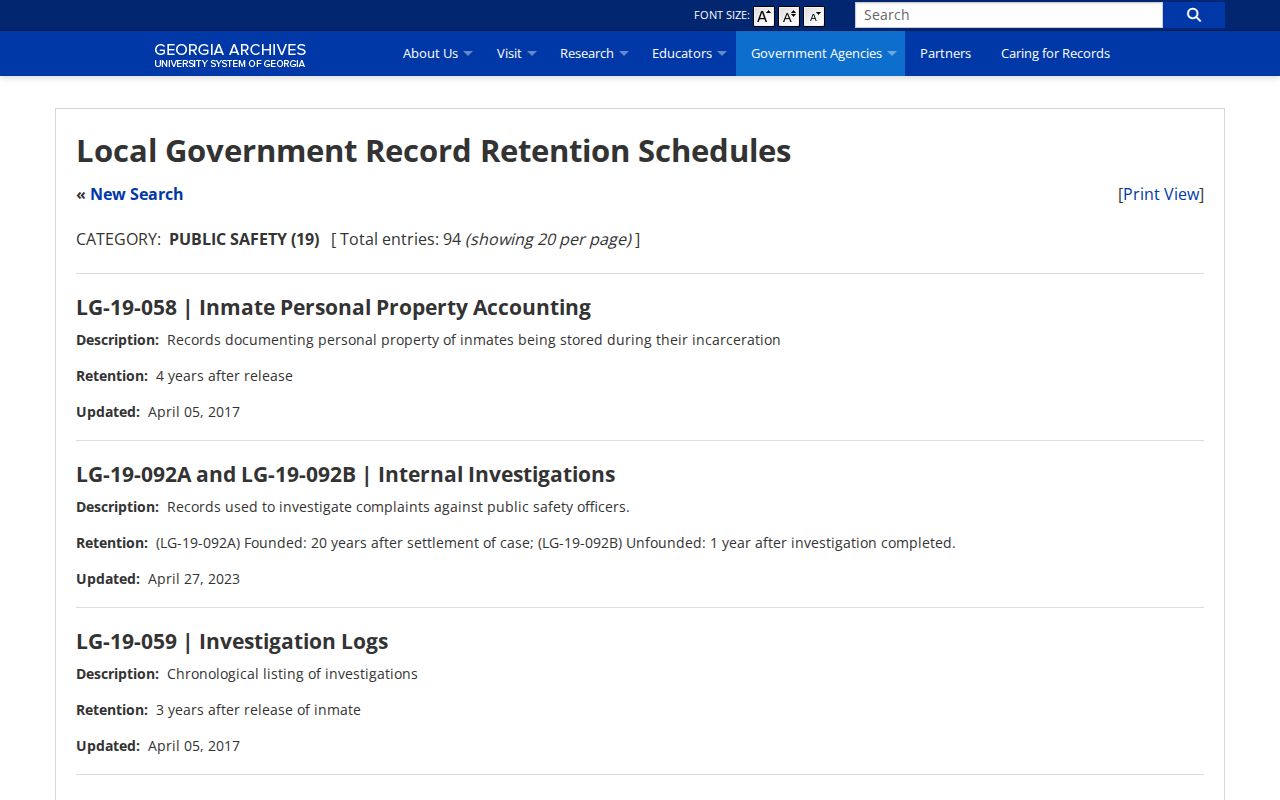
How long do old Columbia County busted records last? The Georgia Archives public-safety schedule sets the floor, under O.C.G.A. § 50-18-92. A jail booking record is kept at least 10 years after release. Jail registers and inmate case files carry the same 10-year minimum, tied to their final entry or release date. Daily incarceration lists need only one year. Arrest and booking summary statistics need five. A web list you once saw can vanish long before the underlying booking file hits its retention endpoint.
One quirk: the schedule never names mugshots as their own record series. Reading a booking photo as part of the booking record it was filed with is sensible. Still, CCSO should confirm whether a requested image still exists. It may have been destroyed, transferred, microfilmed, or redacted under an approved schedule. Meeting the minimum is not website display, and it is not automatic destruction on day one either.
For official timing on old jail records, the Georgia Archives public-safety retention schedule is the document to consult.
Chasing an old Columbia County record? Start with CCSO Records. If staff say they no longer hold the material, ask a follow-up: was it destroyed under the schedule, or transferred through an approved process? Ordinary county booking files do not land in the Georgia Archives collections by default. Court records run on separate judicial retention rules and may outlive a jail list by decades.
Note: The one-year minimum for daily lists does not shorten the ten-year booking-record minimum in Georgia.
Federal and ICE Custody Are Separate
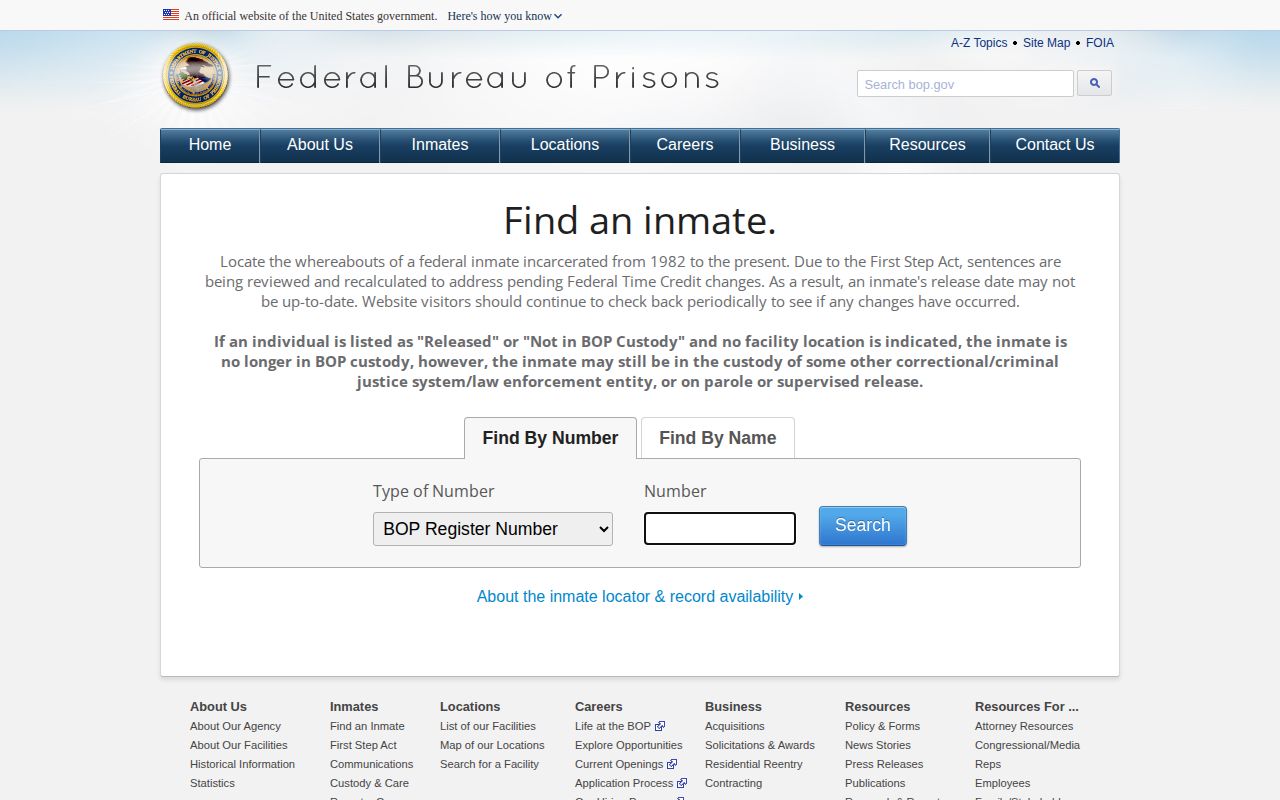
Federal custody works on its own track. The Federal Bureau of Prisons inmate locator covers BOP custody and historical federal records within its published range. Someone held merely on Columbia County charges will not appear there. Searches run by name or by federal register or identification number. The public results include no inmate photographs. A federal defendant awaiting proceedings may sit in a contract or local facility without ever showing up as a sentenced BOP prisoner.
For ICE detention, the right tool is the ICE Online Detainee Locator System. It searches by A-number plus country of birth, or by biographical data. It is not a county mugshot source. A blank result tells you nothing about immigration status, and neither does a nationality entry or a detainer reference. The U.S. Marshals Service also moves people through federal custody. Its materials were never meant to serve as a Columbia County booking log.
The BOP inmate locator interface shows how the federal custody path stays separate from any county roster.
Columbia County Custody Glossary
Each term below marks a different point on the arrest-to-disposition path. Getting the word right helps a request reach the proper desk. It also keeps a booking record from being confused with a court result.
- Booking
- Jail intake after an arrest. Staff record identity details, charges as booked, property and other intake information.
- Arraignment
- A court stage when the accused is informed of filed charges and enters or prepares for a plea. It is not the booking event.
- Bond
- Money, property or another security or condition tied to release. Bond is not a fine and does not resolve the case.
- Disposition
- The court's recorded outcome, such as dismissal, plea, verdict or sentence. It is the source for what happened after the charge.
- Detainer
- A custody-process request from another authority. It is not a conviction and does not by itself describe the local case outcome.
- Record restriction
- A legal limit on access to eligible criminal-history information. It does not automatically destroy every copy held by every publisher or agency.
Busted Mugshots by Columbia County City
City and county records split the arrest path in Columbia County. Grovetown and Harlem each run their own municipal police departments. Those agencies keep the record of the initiating incident. Adults who need county confinement go elsewhere. That would be the Columbia County Detention Center. Appling holds the county seat, yet it is unincorporated and has no police department of its own. CCSO handles law enforcement there and runs the jail.
- Grovetown Busted Mugshots covers the city police path, the county booking destination and the city's aggregate weekly activity reports.
- Harlem Busted Mugshots covers Harlem Police, the CCSO dispatch relationship, city records and the county jail handoff.
- Appling Busted Mugshots covers CCSO as the local agency, the county-seat setting and the absence of an Appling police blotter.
Watch the county tag on a secondary archive. It may point to where the booking was processed, not where the arrest happened or where the person lives. So skip the guesswork. Go to the city agency for the original report, CCSO for the jail record, and the court clerk for how the case ended. That chain beats assuming every Columbia County booking ties back to Appling, Grovetown, or Harlem.